
Why Your Bali Property is at Risk Without Valid PBG and SLF Permits ?
In accordance with Government Regulation No. 16 of 2021, the landscape of Indonesian building permits has evolved from the old IMB system to the more rigorous Persetujuan Bangunan Gedung (PBG) and Sertifikat Laik Fungsi (SLF). These are not merely administrative hurdles; they are essential technical standards designed to ensure that every structure—from private villas to commercial resorts—is planned, built, and maintained according to strict safety, health, and environmental criteria. While the PBG grants you the legal right to construct, the SLF is your official certification that the building is safe to inhabit and operate.
Neglecting the processing of PBG, SLF, and AMDAL/UKL-UPL is not just an administrative oversight, it is a high-stakes legal risk that can jeopardize your entire investment in Bali.
1. Risks of Not Having PBG (Persetujuan Bangunan Gedung)
Mandatory Construction Halts: Local authorities (Satpol PP) have the power to issue "Stop Work" orders, freezing your project mid-construction and causing massive financial losses due to contractor delays.
Forced Demolition: If a building is constructed without a PBG and is found to violate regional zoning (Zonasi) or safety standards, the government can order a mandatory demolition at the owner’s expense.
Heavy Administrative Fines: Under PP No. 16 of 2021, fines for building without a permit can reach up to 10% of the total building value
Inability to Obtain SLF: Without a valid PBG, you cannot apply for an SLF, which effectively makes the building "unusable" in the eyes of the law.
2. Risks of Not Having SLF (Sertifikat Laik Fungsi)
Operational Shutdowns: For commercial properties like villas, hotels, or restaurants, an SLF is a prerequisite for a valid Business License. Without it, your business can be sealed and closed by the regional government.
Platform De-listing: Major booking platforms (Airbnb, Booking.com, etc.) are increasingly requiring verified legal documentation. Properties without an SLF risk being banned or losing their "Verified" status.
Insurance Claim Rejection: If an accident (fire, structural failure, or natural disaster) occurs, insurance companies will often deny claims if the building does not have a valid SLF, as it is officially deemed "unfit for use."
Financing Obstacles: Banks and financial institutions will not approve mortgages or business loans for properties lacking this certificate.
3. Risks of Not Having AMDAL or UKL-UPL
Revocation of NIB (Business ID): Environmental approval is now a "mother permit" in the OSS (Online Single Submission) system. If your AMDAL or UKL-UPL is missing or revoked, your entire Business Identification Number (NIB) becomes invalid.
Criminal Charges: Under Law No. 32 of 2009, operating a business that significantly impacts the environment without an AMDAL can lead to criminal prosecution, including prison time and massive environmental restoration fines
Social Conflict & Reputational Damage: Projects without environmental clearance often face intense opposition from local communities (Banjar) and environmental activists, which can lead to protests and a permanent "blacklist" status in the region.
Government Coercion: The government can apply "Second-Layer Enforcement," where the central government steps in to impose sanctions if local authorities fail to act on environmental violations.
Understanding the "Functionality" in SLF is key to protecting your investment. An SLF (Certificate of Worthiness)serves as a guarantee that a building has undergone a comprehensive technical inspection and is deemed fit for its intended use. For businesses in Bali’s hospitality and commercial sectors, this certificate is a prerequisite for obtaining further operational licenses and insurance coverage. It acts as a shield, verifying that the mechanical, electrical, and structural systems meet national safety benchmarks, thereby minimizing risks to occupants and owners alike.
The Foundation of Responsible Development. In today’s regulatory environment, building a structure requires more than just architectural plans; it demands a commitment to environmental stewardship. Alongside the transition from IMB to PBG (Building Approval) and SLF (Certificate of Worthiness), the Indonesian government mandates rigorous environmental assessments: AMDAL (Environmental Impact Assessment) for large-scale projects and UKL-UPL (Environmental Management and Monitoring Efforts) for medium-impact developments. These documents are the legal prerequisite for obtaining your Business Identification Number (NIB) and ensuring that your project aligns with Bali’s ecological preservation goals.
Protecting Ecosystems through UKL-UPL and AMDAL. The AMDAL and UKL-UPL processes are designed to identify, predict, and mitigate any potential negative impacts your project may have on the surrounding nature and community. From waste management systems to water usage and land conservation, these permits ensure that luxury and development do not come at the cost of Bali’s unique environment. Successfully securing these approvals demonstrates to investors, authorities, and the community that your property operates with a "conscious investment" mindset, prioritizing long-term sustainability over short-term gains.
Don’t Get Shut Down!
Secure Your Environmental and Structural Permits Before Regional Inspections Begin
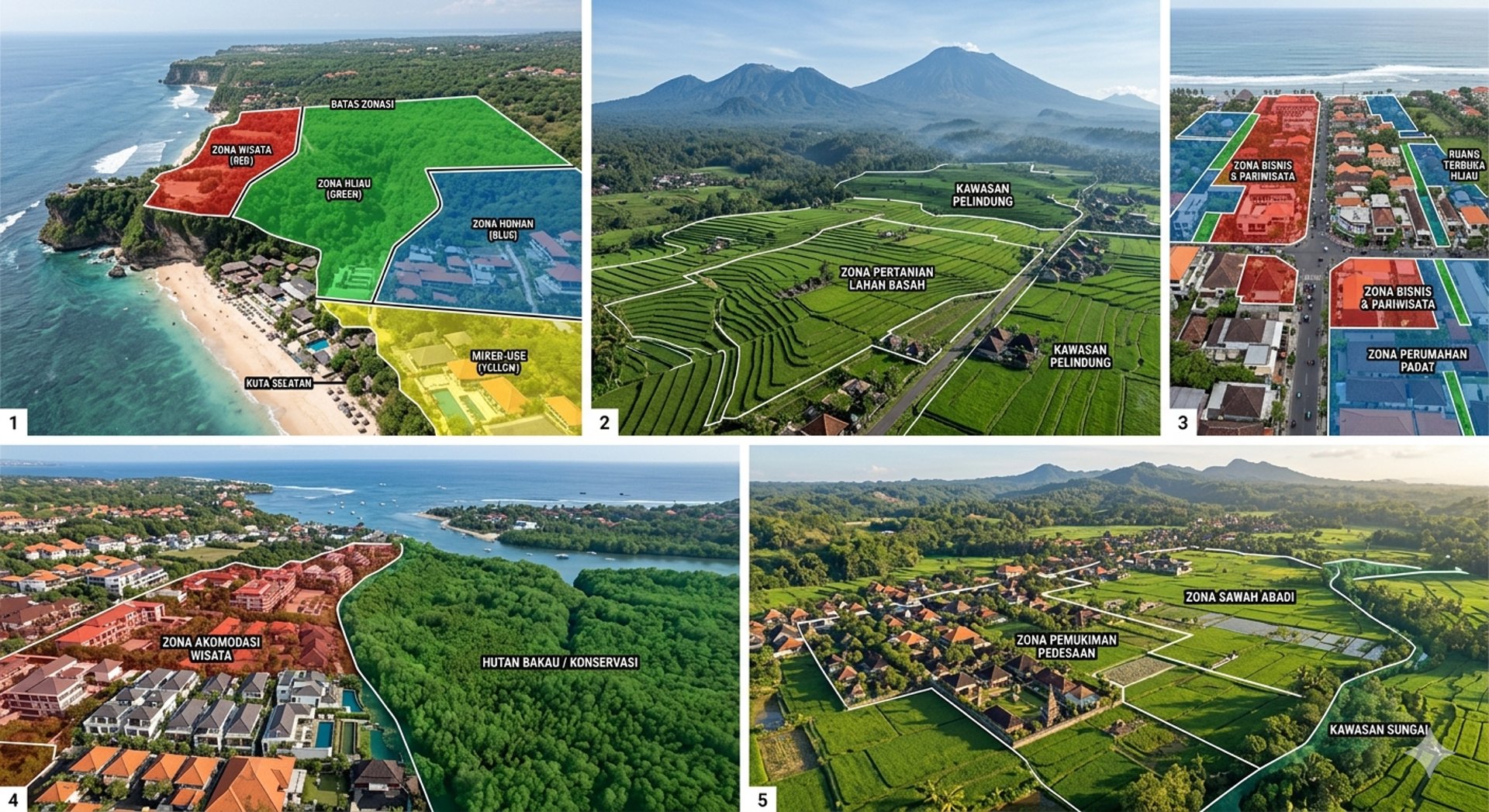
Is Your Property Safe Under Bali’s New Zoning Laws?
The zoning and spatial planning landscape in Bali has undergone a massive transformation, shifting from traditional rigid zoning to a more dynamic, environmentally-conscious, and integrated system. This overhaul is designed to curb rapid overdevelopment, protect agricultural subak land, and strictly enforce structural compliance.
Here is an analysis of the new zoning regulations in Bali, including the specific regulatory frameworks, governing laws (Perda), and their operational rules.
1. The Core Regulatory Framework: Perda No. 2 of 2023
The primary governing law for Bali's modern spatial planning is Peraturan Daerah (Perda) Provinsi Bali No. 2 Tahun 2023 tentang Rencana Tata Ruang Wilayah (RTRW) Provinsi Bali Tahun 2023-2043. This 20-year master plan integrates land, sea, and air zoning into a single unified framework, replacing older local zoning laws to align with Indonesia's national Omnibus Law (UU Cipta Kerja).
Key Rules under Perda No. 2/2023:
The "One Spatial Plan" Integration: It integrates the terrestrial spatial plan with the coastal and marine zone plan (RZWP3K). Any coastal or beachfront development in areas like Uluwatu, Canggu, or Nusa Penida must clear strict marine-boundary zoning checks.
Subak Protection (LSD/LP2B): To combat the rapid conversion of green zones into villas, this Perda strictly protects Lahan Sawah Dilindungi (Protected Rice Fields) and Lahan Pertanian Pangan Berkelanjutan (Sustainable Food Agricultural Land). Building on these designated green zones carries severe legal and criminal penalties.
Sacred Zone Radial Distances (Kawasan Suci): The law reaffirms the protection of sacred temple zones (Kawasan Tempat Suci). Depending on the temple’s hierarchy (e.g., Pura Sad Kahyangan or Pura Dang Kahyangan), there are strict radial zones where zero commercial or tourism construction is allowed.
2. Digitalization of Zoning Checks: The KKPR System
Under national regulations governing regional spatial plans (PP No. 21 Tahun 2021 tentang Penyelenggaraan Penataan Ruang), zoning verification in Bali is no longer an ambiguous local recommendation. It is officially processed digitally as KKPR (Kesesuaian Kegiatan Pemanfaatan Ruang) via the central OSS (Online Single Submission) system.
The Mechanism: Before an investor can acquire land or apply for a building permit, they must obtain an official ITR (Informasi Tata Ruang) or KKPR approval. If the coordinates of the land overlap even slightly with a protected green zone (Zonasi Hijau) or agricultural zone, the digital OSS system will automatically block further licensing.
3. The Strict Linkage: Zoning, PBG, and SLF
Zoning checks are the absolute prerequisite for the two most critical building certificates required in Bali:
PBG (Persetujuan Bangunan Gedung): Replaced the old IMB framework under PP No. 16 Tahun 2021. A property cannot obtain a PBG if its technical layout violates local architectural zoning laws—specifically the Bali Height Limit of 15 Meters (mandated to protect the cultural landscape and remain lower than a coconut tree) and Balinese traditional architectural styling elements.
SLF (Sertifikat Laik Fungsi): This certificate verifies that a building is structurally, environmentally, and legally fit for operation.
4. Platform Enforcement and Delisting Risk
The urgency surrounding zoning and building compliance has escalated significantly. Under strict enforcement guidelines, Online Travel Agencies (OTAs) and digital booking platforms (such as Airbnb, Booking com, and Agoda) are actively collaborating with Indonesian regulatory authorities. Properties operating in incorrect zones or those lacking valid PBG and SLF certifications face immediate delisting from these platforms and operational freezes by local authorities (Satpol PP).
Navigating Bali's zoning requires a strict, multi-layered validation process before any capital deployment:
Zoning Check (ITR/KKPR)⟶Environmental Clearance (AMDAL/UKL-UPL)⟶Building Permit (PBG)⟶Operational Certificate (SLF)
Ensuring a property is perfectly aligned with Perda No. 2/2023 is no longer just a legal formality—it is the single most vital step to safeguarding property assets from fines, delisting, or demolition.

Ready to Invest? Do You Know the New PT PMA Rules for Bali?
The rules governing PT PMA (Foreign-Owned Company) setups in Bali and across Indonesia have evolved significantly, heavily shaped by the ongoing implementation of the Omnibus Law (UU Cipta Kerja) and updated investment regulations. If you are guiding high-net-worth investors or structuring land deals for commercial development, the legal landscape is tighter, more digitalized, and demands strict compliance.
Here is the breakdown of the major updated rules for setting up and maintaining a PT PMA in Bali as of 2026:
1. Increased Minimum Capital Requirement (The Big Shift)
The days of vague financial statements are over. BKPM (The Investment Coordinating Board) strictly enforces high capital requirements to ensure foreign investment genuinely benefits the macroeconomy.
The Rule: The minimum authorized and paid-up capital for a PT PMA is IDR 10 Billion per KBLI (Business Classification Code).
The Catch for Multi-Sector Businesses: If your PT PMA operates in two distinct sectors—for example, Real Estate/Villa Ownership (KBLI 68111) and Villa Management/Hospitality (KBLI 55120)—BKPM considers these as two separate KBLI groups. This means your total minimum capital requirement scales up to IDR 20 Billion.
2. Strict Linkage to Zoning (KKPR & OSS RBA)
A PT PMA can no longer just choose an address and start operating. Everything runs through the OSS RBA (Risk-Based Approach) digital system, which is hard-linked to regional spatial planning laws (Perda No. 2 of 2023 for Bali).
Zoning Pre-approval (KKPR): Before the corporate system issues an operational license, the location of the PT PMA must clear the KKPR (Spatial Utilization Conformity Check). If a foreign investor sets up a real estate PT PMA but the coordinates lock onto a protected green zone (Zonasi Hijau) or agricultural Subak land, the digital system will instantly freeze the application.
3. Strict Restrictions on Property Ownership (KBLI 68111)
For foreign investors looking to buy, build, or lease land in Bali through a PT PMA, BKPM has set explicit boundaries on what a foreign-owned corporation can and cannot do:
No Single-Unit Retail Speculation: A PT PMA under KBLI 68111 (Real Estate) cannot buy a single residential house or small individual villa just to resell it like a local broker.
The Master Developer Rule: To operate legally in real estate, the PT PMA must function as a developer. This means purchasing a larger parcel of land to build a complex, a resort, a condominium, or an interconnected residential compound.
The Title: A PT PMA cannot own land under Hak Milik (Freehold). Instead, it secures the land under Hak Guna Bangunan (HGB) (Right to Build) or Hak Pakai (Right to Use), which are safe, renewable corporate titles perfectly suited for foreign entities.
4. Mandatory LKPM Financial Reporting Audits
BKPM has cracked down heavily on "dormant" or paper-only PT PMAs in Bali.
Quarterly Reporting: Every active PT PMA is legally required to submit an LKPM (Investment Activity Report) every quarter via the OSS system.
The Risk: If a company fails to submit its LKPM for consecutive quarters, or fails to show progress toward realized investment (spending that IDR 10 Billion capital), the central government will automatically suspend the NIB (Business Identification Number), rendering the company—and its ability to process KITAS or building permits—completely inactive.
5. The KITAS & Investor Visa Tightening
Following the introduction of Indonesia's Golden Visa programs and updated immigration frameworks, standard Investor KITAS regulations have been refined.
Director/Shareholder Requirements: To qualify for a standard Investor KITAS, a foreign investor must hold a minimum share value of IDR 1 Billion within the PT PMA, and the company's overall paid-up capital must clear the IDR 10 Billion mark.
Active Status: Immigration and BKPM cross-check records. If the PT PMA is not actively paying corporate taxes or filing LKPMs, investor visas linked to that entity risk non-renewal or revocation.
PT. SANGKARA DEWATA ASIA
Copyright © PT Sangkara Dewata Asia 2024 All rights reserved.
Privacy Policy. This site is protected by reCAPTCHA and the Google Privacy Policy and Terms of Service apply.
Web design by Digi Design Studio
Zoning Regulations
PBG and SLF
Sky Site Tour
Investor Highlight
Projects
Permits
Sustainable Development
Asset Recovery
Villa Rental